
How we use a SIEM to keep your infrastructure safe
A behind-the-scenes look at the monitoring that runs 24/7 on Lusonode - what a SIEM actually does, why we built ours the way we did, and what it means for you as a customer.
Most of the time, good security is invisible. Your server boots, your site loads, your players connect and nothing strange happens. That quiet isn’t luck. Behind it is a system that never sleeps, reading the signals our infrastructure gives off and picking out the ones that fall outside what’s normal.
That system is our SIEM (Security Information and Event Management). We don’t talk about it much because, honestly, it’s behind-the-scenes infrastructure. Like the plumbing in a building: you never see it, but if it fails, nothing works the way it should. That’s exactly what lets us keep a stable network and a small attack surface. So here’s an honest look at what it is and how it protects you.
What a SIEM actually does
Every piece of our infrastructure is constantly generating signals. Firewalls log connection attempts. Hypervisors record events like virtual machines starting and stopping. Authentication systems log every sign-in, successful or not.
On their own, this data doesn’t say much, it’s just millions of log lines scattered across dozens of systems.
A SIEM brings it all into one place and gives it context.
Think of it as the difference between having hundreds of security cameras with nobody watching them, or one control room where every signal comes together and where there’s something (and someone) ready to notice when seemingly isolated patterns start to form a story.
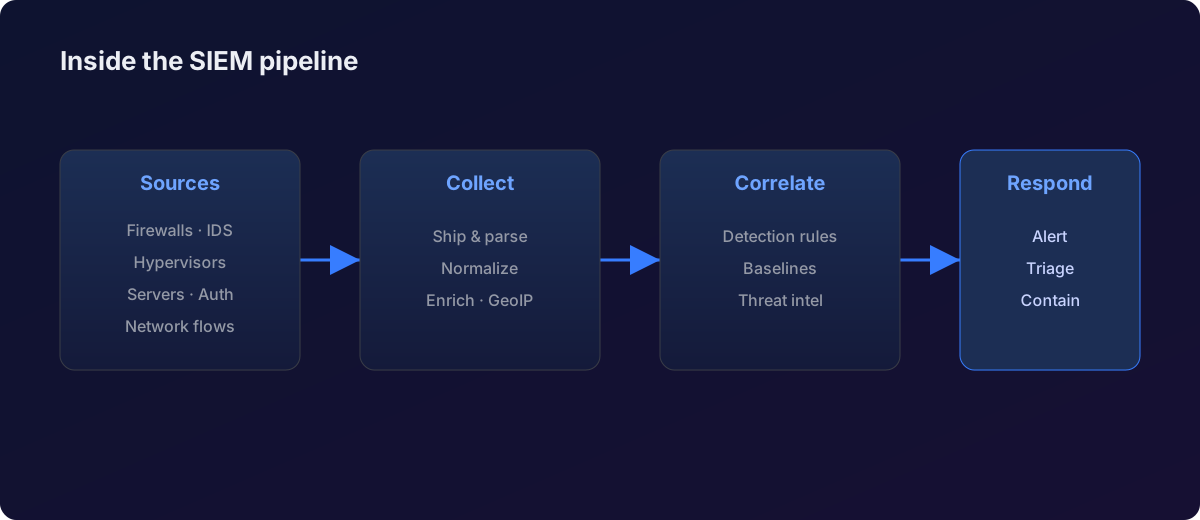
In practice, the data moves through four stages:
- Collect - agents ship logs from every server, firewall, and network device.
- Normalize - different log formats are transformed into a common shape and enriched with context, like geolocation or known-bad IP lists.
- Correlate - detection rules and behavioural baselines analyse everything together, hunting for patterns that would be invisible in isolation.
- Respond - suspicious events raise alerts, are triaged automatically and, when needed, trigger containment mechanisms.
Why correlation makes all the difference
A single failed sign-in doesn’t say much. The same goes for a port scan, or a slight CPU spike on a machine.
But when these signals show up in sequence, especially in the same context, they stop being noise and become a story.
For example: a failed sign-in from a new country, followed by a port scan, followed by an unusual outbound connection from that same machine. None of these events would be enough on its own. But together they tell a different tale.
The problem is that no individual server can see this. Each one only knows its own small part. The SIEM, on the other hand, sees the whole at once and that’s exactly why real security lives in correlation, not in simply logging events.
The goal isn’t to collect more data. It’s to find the one event in millions that truly matters before it becomes a problem.
What this means for you
In practice, you don’t need to configure any of this, and you’ll probably never interact with it directly. But it’s working for you around the clock:
- You’re monitored, not watched. We analyse security signals (connection, authentication and behaviour patterns) not the contents of your applications or data. The goal is to detect attacks, not to snoop on information.
- Threats are caught earlier. By correlating signals across the whole platform, a suspicious pattern detected on one customer can help protect everyone else. Block it once, and it’s blocked for the entire network.
- Incidents leave a clear record. If something does happen, we have a precise timeline of what occurred which speeds up investigation and resolution.
- It runs 24/7. Attacks don’t pick their hours, so neither does detection. It all happens automatically, at machine speed.
Defence in depth, not a single barrier
The SIEM doesn’t work alone. It’s integrated with our multi-Tbps DDoS protection, the LNSHIELD game firewall, network segmentation, and several layers of server hardening.
Each layer assumes the others might fail and that’s exactly what makes the approach resilient. The SIEM is the layer that ties it all together, giving us a single, consistent view of what’s happening at any moment.
Security is never “finished”. We continuously tune detection rules, add new data sources, and adjust what we consider normal behaviour.
But the principle stays the same: watch what matters, understand it in context, and act before small signals turn into real incidents.
This is the quiet work that keeps your projects fast, protected, and online even when nobody’s looking.